ByJohn A
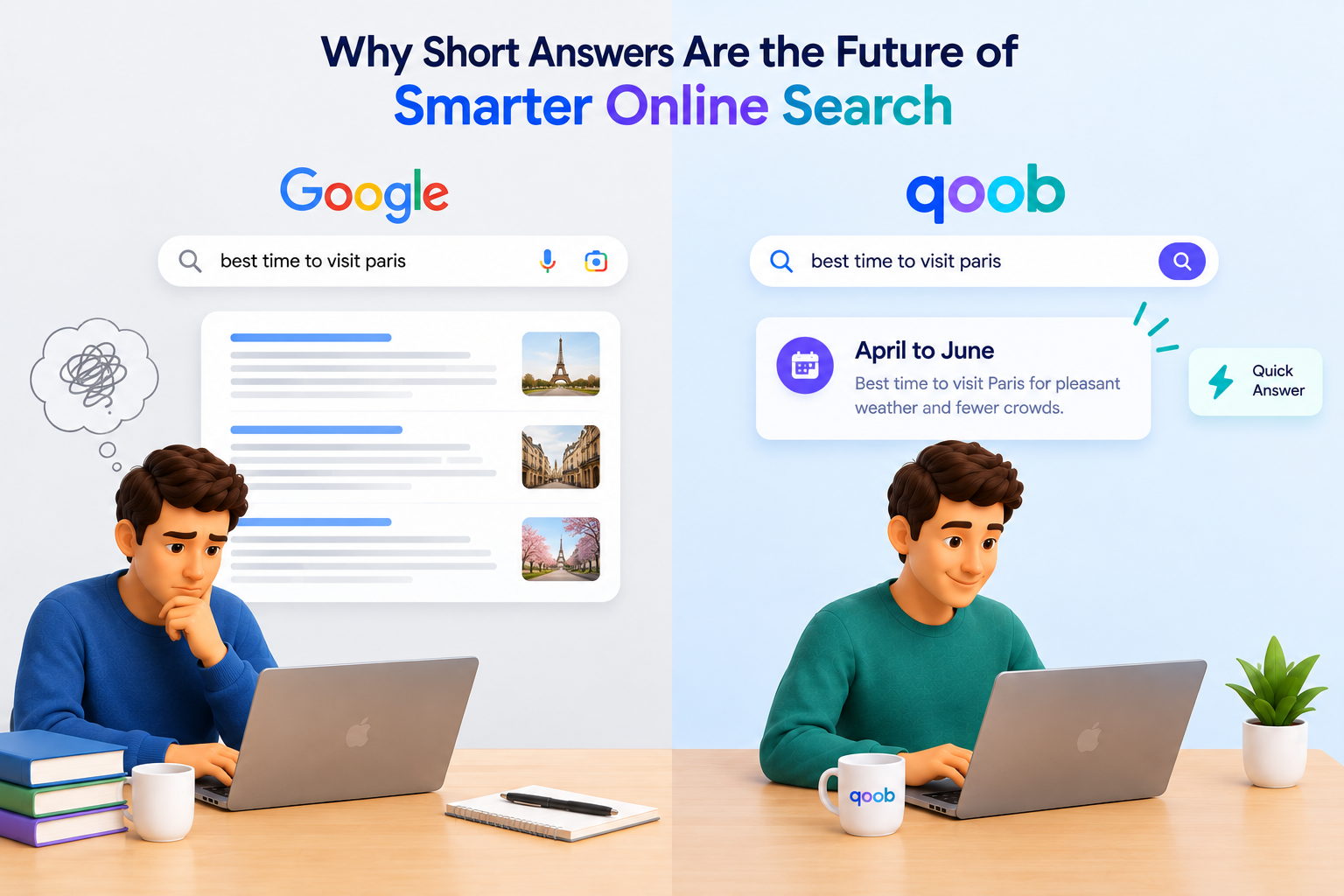
Why Short Answers Are the Future of Smarter Online Search
The way people search for information online is changing. For years, search engines have primarily provided users with pages of links, requiring them to open different websites, compare information and find the answer themselves.
That approach can still be useful for detailed research. However, many everyday searches do not require dozens of websites or lengthy explanations. People often want one thing: a clear answer that helps them understand something, make a choice or decide what to do next.
This is where short answers are becoming increasingly important. AI powered search experiences are changing the focus from simply finding information to understanding information more quickly.
Instead of spending several minutes browsing through results, users can ask a question naturally and receive a concise response designed around their needs.
Explore Short Answers With Qoob
For users looking for a cleaner way to search, short answers can provide a more direct starting point for everyday questions. Qoob’s search experience is designed around concise responses that help users understand information and move toward a decision without unnecessary browsing.
The Problem With Traditional Search Results
Traditional search engines have made information widely accessible. A simple query can produce thousands or even millions of results.
The challenge is that users still need to do much of the work themselves. They may need to open multiple pages, compare sources, ignore irrelevant results and decide which information is useful.
For complex research, that process can be valuable. For a simple everyday question, it can create unnecessary effort.
Information Does Not Always Mean Clarity
More information is not automatically better information.
When users are presented with too many results, they can experience information overload. Instead of making a decision quickly, they spend more time deciding which result to trust.
A smarter search experience focuses on relevance and clarity rather than simply providing more links.
What Are Short Answers in AI Search?
Short answers are concise responses that focus on the main information a user needs.
They are not necessarily about removing useful details. Instead, they are about presenting the most relevant information first and avoiding unnecessary filler.
AI search can make this approach possible by understanding the meaning behind a question and producing a response that is focused on the user’s intent.
Short Does Not Mean Incomplete
A useful short answer should still provide enough context to be meaningful.
For example, if someone asks about the difference between two products, simply naming one product may not be enough. A better short answer can explain the main difference and mention the factor that matters most for the decision.
The objective is to make information easier to understand without overwhelming the reader.
Why People Prefer Faster Answers
Modern internet users are surrounded by information. They search on phones, laptops and tablets throughout the day, often while doing something else.
When someone searches for a quick fact, comparison or recommendation, they may not want to spend ten minutes reading multiple pages.
A concise answer can reduce the amount of time between asking a question and understanding the result.
See also: Benefits of Using AI Flyer Makers for Small Businesses
Everyday Questions Need Practical Answers
Many online searches are simple and practical.
They might include:
- What should I cook tonight?
- Which option is better for my needs?
- How does this work?
- What should I consider before buying this?
- Where should I go this weekend?
These questions are often connected to an immediate decision. A short, relevant answer can be more useful than a long list of search results.
AI Search Is Changing the Search Experience
AI has introduced a different approach to online search.
Instead of relying only on keywords, AI search can interpret natural language and understand the intent behind a question. This allows users to search in a conversational way.
Qoob describes its search experience as providing short, trustworthy answers rather than a large collection of links or lengthy AI generated text.
This approach puts greater emphasis on the answer itself.
From Keywords to Intent
Traditional search often depends heavily on the words entered into the search box.
AI search can focus more on what those words actually mean in context.
For example, someone might ask, “What is a good place to visit this weekend with children?”
The important information is not just the phrase “places to visit.” The question also contains context about timing and the type of experience the user wants.
Understanding this intent can make the resulting answer more relevant.
Short Answers Can Reduce Information Overload
The internet contains an enormous amount of information. While this is useful, it can also make simple decisions unnecessarily complicated.
Imagine searching for a product and opening ten different pages. Each page may contain specifications, advertisements, reviews, comparisons and recommendations.
You may eventually find the information you need, but the process takes time.
A concise AI search answer can bring the most relevant points together so users can understand the situation more quickly.
Less Searching, More Understanding
The purpose of a better search experience is not necessarily to eliminate detailed research.
Instead, it can help users identify the important information first.
If the question is simple, the answer can remain simple. If the question requires deeper research, users can continue exploring.
This creates a more flexible search experience.
Short Answers Are Useful for Everyday Decisions
Search is often associated with research, but much of our daily searching involves small decisions.
People search for recipes, travel ideas, product comparisons, explanations, activities and solutions to everyday problems.
Qoob positions its smart search experience around these everyday decisions, providing clear and concise answers intended to help users decide and move forward.
Common Everyday Uses
A short answer can be particularly useful when someone wants to:
- Compare two products
- Find a simple recipe idea
- Plan a weekend activity
- Understand an unfamiliar topic
- Decide between different options
The value comes from reducing the effort required to get from a question to a useful next step.
Personalisation Makes Short Answers More Useful
A short answer is only useful if it is relevant.
Two people can ask the same question but have different priorities. One person may care about price, another about convenience and another about quality.
Personalised search attempts to account for this context.
Qoob says its answers can be shaped around information users provide, their questions and their preferences, allowing responses to be more relevant to the individual.
Context Improves Relevance
Consider the question, “Which laptop should I buy?”
A generic answer could list several popular laptops.
A more useful search experience could take into account whether the user needs the laptop for business, gaming, study or travel.
The more relevant the context, the easier it can be to provide a useful answer.
Why Short Answers Can Improve User Experience
Good user experience is about reducing unnecessary friction.
When users search for something, they should not have to fight through excessive advertising, irrelevant content or complicated interfaces before reaching useful information.
A concise answer creates a cleaner path between the question and the information.
Qoob’s search platform emphasises a clean experience with direct answers and less clutter around the information users are looking for.
Clarity Creates Confidence
Clear information can make decisions feel easier.
When the main points are presented in an understandable format, users can quickly identify what matters and decide whether they need additional research.
This does not mean every decision should be made from a single answer. Instead, short answers can provide a useful starting point.
Short Answers vs Long AI Responses
AI tools have made it possible to generate extremely detailed responses.
This can be useful when someone wants an explanation, tutorial, report or creative content. However, long responses are not always appropriate for simple questions.
If someone asks for a quick explanation, a long response can create the same problem as a long list of search results.
Matching Answer Length to User Intent
The ideal answer depends on the question.
A simple factual question may need only a few sentences.
A complex technical question may require several sections and examples.
Smarter search should therefore focus not simply on making answers shorter, but on making them appropriately concise for the user’s purpose.
The Importance of Trust in Short Answers
Conciseness alone does not make an answer useful.
Users also need confidence that the information is relevant and reliable.
When an answer is short, every sentence matters. There is less room for unnecessary information, so the response needs to focus on the details that actually answer the question.
Qoob describes its platform as providing short, trustworthy answers and says that a recent survey of more than 1,000 people found its answers were widely considered trustworthy and easy to understand. This is a company reported survey claim rather than an independent assessment.
Users Still Need to Think Critically
AI search should support decision making rather than replace personal judgement.
For important topics such as health, law, finance or safety, users should verify information through appropriate authoritative sources.
Short answers are most useful when they help users understand a topic quickly while still leaving room for deeper research when necessary.
Why Short Answers Could Shape the Future of Search
The future of online search may involve a greater focus on intent, relevance and usability.
People do not always want to browse. Often, they simply want to know something.
AI search can help move search from a process of discovering pages toward a process of understanding information.
Qoob describes this approach as bridging the gap between curiosity and action by turning large amounts of information into clear, short answers for everyday decisions.
From Searching to Deciding
This represents an important shift.
Traditional search asks users to find the answer themselves.
AI search can help bring the answer closer to the user.
The difference may seem small, but it can significantly change how people interact with online information. Instead of opening multiple tabs for every question, users can start with a direct answer and explore further only when they need more detail.
How to Get More Value From Short AI Answers
Users can also improve the quality of the answers they receive by asking clear questions.
You do not necessarily need complicated prompts. A straightforward question with relevant context can often produce a more focused response.
For example, instead of asking, “Best phone?”, you could ask, “Which phone is suitable for photography and everyday use under my budget?”
The second question gives the search system more information about the intended decision.
Ask With the Outcome in Mind
Before searching, think about what you actually want to accomplish.
Do you want to understand something, compare options, solve a problem or make a decision?
When the intended outcome is clear, an AI search system has more context to work with.
Final Thoughts
The future of search is not necessarily about giving users more information.
It is about giving them the information they need in a form they can understand and use.
Short answers can reduce information overload, save time and make everyday searches more convenient. When combined with natural language understanding and personal context, they can turn search from a browsing exercise into a more focused decision making experience.
Traditional search will continue to have an important role, particularly when users need extensive research or want to explore different sources. AI search adds another option for situations where the user wants a clear answer quickly.
As online search continues to evolve, the ability to provide relevant, concise and useful information may become increasingly important.
Qoob is a smart search platform focused on providing clear, personalised answers for everyday questions and decisions.